Same points, through time
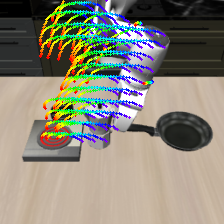
Persistent point correspondence ties the robot and objects to their future trajectories.
for World Action Models
† Corresponding authors
Learning how the robot and objects move.
Turning future 3D motion into better actions.
World Action Models couple future visual prediction with action generation. But successful manipulation depends on how the robot and task-relevant objects move—not just how the next frame looks.
Trace-WAM adds future 3D motion prediction as an auxiliary objective. Tracking the same points through time captures both image-plane displacement and depth change, providing a direct learning signal for interaction dynamics.
Learn with future motion.
Act from current observations.
Joint training enriches the representations used for action generation.

Tri-MoT architecture. Three Transformer experts jointly learn video prediction, 3D motion prediction, and action generation. At inference, action denoising uses cached visual features; future-video and motion prediction are removed.
View full resolutionPersistent point correspondence ties the robot and objects to their future trajectories.
Image displacement and depth change describe motion in a unified reference-camera frame.
Deployment uses a single visual forward pass and action denoising, without future motion generation.
Three tasks on a Piper robot, from precise placement to sustained interaction.
Place the bread in the bowl.
Place the object inside, then close the drawer.
Erase the chalk markings from the board.
+21.7 percentage points in average success over Fast-WAM. Explore the complete results ↓
From diverse manipulation tasks to seven dimensions of distribution shift.
RoboCasa-GR1
RoboCasa-GR1
RoboCasa-GR1
Success rates across three simulation benchmarks.
Explore the full method, experimental results, and the details behind motion-auxiliary learning.
Read the paper Trace-WAM
Learning to Act via 3D Motion Prediction for World Action Models